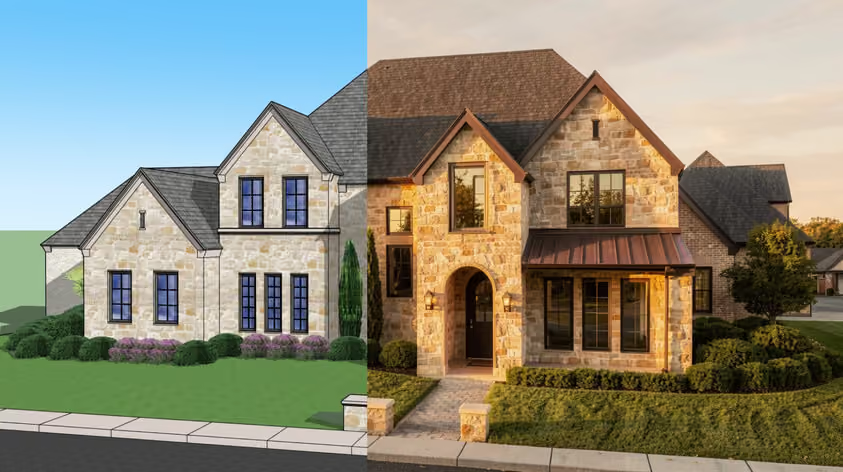
SketchUp’s pricing page looks simple at first glance. But once you factor in extensions, rendering tools, training, and hardware, that $399/year Pro license quickly becomes just the starting point.
If you're a solo architect, a growing design firm, or an interior design studio, you need a clear picture of the true cost so you can budget properly and avoid surprises later.
This guide breaks down every SketchUp pricing plan, explains what they include, and helps you match the right option to your workflow.
You’ll also see the extra costs that most buyers overlook, from rendering engines to paid plugins (like MyArchitectAI) and performance upgrades. By the end, you’ll have a clear picture of whether SketchUp is worth the cost for your design workflow.
Let’s jump right in.
As of July 2025, Trimble updated their pricing structure. Here's what each plan costs now:
All prices are per user, and subscriptions auto-renew unless you cancel. Monthly billing is available for Go and Pro, while Studio is annual-only.
SketchUp Go costs $19.99/month or $129/year. It's designed for designers who want flexibility, like modeling on iPad when you're on-site, and switching to web when you're at your desk.
Go's limits aren't obvious from the pricing page: it's web-only, with no desktop app and no access to the Extension Warehouse. That means no V-Ray, no Enscape, and no custom plugins. Go works for occasional model cleanup, viewing shared files, or light modeling from an iPad. For any real production workflow, you need Pro.
SketchUp Go includes:
SketchUp Go doesn't include:
SketchUp Go is solid if you're doing conceptual work and client presentations. But without the desktop app or LayOut, you can't create proper construction documents. That's a dealbreaker for most professional workflows.
SketchUp Pro costs $99.99/month or $399/year. This is what most architecture and design firms actually use.
The price increased from $349 to $399 in July 2025—a $50 bump that had some users grumbling on the forums. Still, Pro remains the sweet spot for professional work.
Pro includes everything in Go, plus:
Here’s why Pro matters for professionals:
The desktop application is faster and more capable than the web version. LayOut turns your 3D models into proper construction documents with dimensions, annotations, and title blocks. And DWG/IFC support means you can actually collaborate with engineers and contractors.
If you're billing clients for design work, Pro is the minimum viable option.
SketchUp Studio costs $819/year. No monthly option.
The Studio plan is for firms that need integrated rendering and BIM connectivity without juggling separate licenses. What’s worth mentioning here is that Studio is Windows-only for the extra plugins (V-Ray, Scan Essentials, Revit Importer, point-cloud functions). Mac users get Pro-level features only.
Studio includes everything in Pro, plus:
Who actually needs Studio:
Studio makes most sense if you're using Windows and already planning to buy V-Ray. The math is simple: Pro ($399) + V-Ray ($540) = $939. Studio bundles them for $819, thus saving you a minimum of $120/year.
But if you don't need V-Ray's photorealistic rendering power, Studio is overkill. There are faster and easier alternatives for most visualization needs.
There's no separate SketchUp iPad subscription. iPad access comes with Go ($129/year), Pro ($399/year), or Studio ($819/year).
Go is the entry point for iPad modeling. Pro and Studio include iPad access, too, so you're not paying extra.
If you only want iPad access and nothing else, Go is your only option. But remember—Go doesn't include the desktop application, which limits what you can do with your models later.
SketchUp offers steep discounts for education:
*These prices may vary among authorized reseller offers.
The student license includes everything in Pro. That's a $344 discount, which is significant if you're learning the software before entering the workforce.
However, educational licenses can't be used commercially, and once you graduate, you'll need to switch to a regular subscription.
Yes, SketchUp Free is the browser-based version that lets you model directly in your web browser. There’s no download, and nothing to install.
What's included:
What's missing:
So, SketchUp Free works fine for personal projects or learning the basics. But if you need to exchange files with clients or create construction documents, you'll hit its limits fast.
Also, forget about working offline.
Trimble discontinued new purchases of the SketchUp Pro Classic License (the permanent, one-time-purchase version) around 2020-2021. Existing Classic users still receive security and compatibility updates, and can run their perpetual version indefinitely, but Trimble no longer sells the perpetual tier to new customers.
If you see older guides or third-party resellers advertising "SketchUp Classic License 2026," they're typically offering used licenses or out-of-date information. The Pro subscription is the only official new-customer path as of 2026.
The SketchUp license price is just the starting point. Here's what else can hit your budget.
Aside from SketchUp Diffusion, which isn't quite ready for client work, SketchUp doesn't do photorealistic rendering on its own. You'll need additional software:
To see which rendering tool fits your workflow, take a look at our guide to the top SketchUp renderers.
The Extension Warehouse has over a thousand extensions. Most are free, but the really useful ones are usually paid. You might spend $100–$300 on essential plugins depending on your workflow. Here are some example extensions and what they add on top of your SketchUp subscription:
SketchUp Campus offers free training resources. But if you want structured professional training, make sure to include it in your budget:
Most SketchUp users can learn the basics in a few hours from free resources. Mastering advanced SketchUp techniques, on the other hand, and especially for rendering, takes longer.
And finally, there are hardware requirements. If you're adding V-Ray or other GPU-intensive renderers, budget $1,500–$3,000 for a workstation that can handle the software.
Let's run the numbers for different scenarios:
Freelancer (basic setup):
Total: ~$500/year
Small firm (3 users, full workflow):
Total: From $3,500/year, plus hardware
Growing studio (needs everything):
Total: ~$6,000/year + hardware
As you can see, a SketchUp subscription is not the only cost you need to budget for. Renderers, plugins, and training add up fast.
Pro tip: Trimble's direct pricing isn't always the cheapest path. Authorized resellers like Novedge (in the US) or Tecnobit (in Italy) often offer 5-15% off on annual subscriptions, especially for multi-seat orders. Also, most local resellers handle regional currencies (TRY in Turkey, IDR in Indonesia, THB in Thailand, INR in India). Prices in emerging markets are often 20-40% lower than in the US if buying through regional resellers. Check a local reseller before committing at USD pricing.
Absolutely. At $399 per year, SketchUp Pro is still one of the most affordable pro-grade 3D modeling tools, especially considering how fast it is to learn and how flexible it is for architectural and interior design work. LayOut alone justifies the upgrade from Go for creating construction documents.
And if, for some reason, you're not convinced by SketchUp, there are plenty of alternatives for architects and designers such as Revit, Rhino, Archicad, and Chief Architect.
SketchUp subscription prices range from free (browser-based personal use) to $819/year for Studio. Most professionals use Pro at $399/year. SketchUp Go costs $129/year for iPad and web access. All paid plans are subscription-based with per-user pricing.
Google sold SketchUp to Trimble in 2012. Today, SketchUp Free is a browser-based version for personal use, with no download required. It's genuinely free but limited compared to paid versions. You can't use it commercially or access desktop features.
You can't legally get a permanent free SketchUp Pro license. However, there are trial and education options:
Some resellers occasionally offer extended trials. Check Trimble's website for current promotions.
Not anymore. Trimble discontinued perpetual "Classic" licenses in November 2020. All SketchUp versions are now subscription-based. If you bought a perpetual license before the cutoff, you can still use that version, but you won't receive updates or new features. Everyone else pays annually or monthly.