Midjourney has been the go-to AI image generator for designers and architects since it launched, mainly because it was the only option worth considering for a while. Even nowadays, it’s widely known as somewhat of a gold standard.
But is it still?
Also, now that the free tier is long gone, an even bigger question is whether Midjourney pricing actually makes sense for your workflow. Does what you're paying line up with what you're getting?
We build AI tools for visualization, so we have a clear insight into what AI can and can't do, as well as what it should and shouldn't cost. So we broke down every Midjourney plan to reveal where the value holds up, and flagged the details that tend to catch people off guard.
Once you decide on the subscription tier, read our guide on prompting Midjourney.
As with most tools today, Midjourney pricing is structured around subscription tiers, so you find four monthly options. The core mechanic it’s based on is GPU time; essentially you're paying for priority access to the servers that run the model. Your plan equals the number of hours of that access you get per month.
That's a different model from tools that charge per image or per credit. In practice, it means a standard image generation in fast mode costs roughly 1 minute of GPU time. Higher-resolution outputs and upscaling operations consume more.
Annual billing knocks 20% off all plans; hence, if you know you'll use Midjourney consistently, paying yearly on the Standard or Pro plan is straightforward math. In any other case, extra fast GPU time is also available on any tier at $4 per hour. It covers you if you run out mid-month, but we’ll get back to the real cost of that part.
This distinction is more important than the headline differences in Midjourney pricing tiers. It's the first thing that separates those tiers in practice.
It generates images in 10 to 30 seconds and draws directly from your monthly GPU hour allocation. In practice, each standard image costs roughly a minute of fast time. Upscaling and running variations can each take 2 to 4 minutes; the same applies to generating at higher resolutions. But once your fast hours are gone, they're gone, no rollover to the next billing cycle.
This mode uses shared GPU resources during off-peak periods. Generation takes anywhere from 0 to 30 minutes (per Midjourney's own docs) which in practice typically translates to 1 to 10 minutes depending on server load. It doesn't consume your fast hour budget at all, and on Standard, Pro, and Mega plans, it's unlimited.
While not exactly stealth, the Relax mode handles ideation and iteration for most workflows just fine. Midjourney pricing tiers unlock this mode on the Standard plan at $30/month, and it notably changes the value of the subscription compared to Basic. Now, speaking of that:
Three and a half hours of fast GPU time counts for roughly 200 images. When those hours run out, generation stops until the next billing cycle (unless you purchase additional fast hours at $4 each). There is no Relax mode to switch to and continue generating at a slower pace.
Basic works as an entry point to test the platform and evaluate whether the image quality justifies committing to a higher tier. For any sustained creative or professional use, it runs out fast, so it’s possible that you’ll move off it even within the first month.
This is where Midjourney pricing starts to make practical sense. Fifteen fast hours give you roughly 900 images in that mode. Relax mode meanwhile covers anything that doesn't need to come out in an instant. For solo creators, including architects who generate concept visuals, the Standard plan handles consistent output reasonably well.
What the Standard plan doesn’t cover is the Stealth Mode, and before you think “The fast is fast enough,” this is not about speed. Every image you generate on Standard is publicly visible in Midjourney's gallery. For personal work or experimental projects, that's mostly fine. But for client-facing design work and in general situations where confidentiality matters, it's not.
The jump from $30 to $60 is steep, but it comes with two things that matter for professional use. The first is Stealth Mode, which keeps your generated images off the public gallery. The second is 12 concurrent jobs, up from 3, which makes a lot of difference when you're running batch generations or iterating on multiple concepts in parallel.
For design professionals doing client work, Pro is effectively the minimum viable tier. That reality makes the $60 price point the actual starting cost for this case, regardless of the listed Midjourney prices.
.avif)
Sixty fast GPU hours for high-volume workflows where the Pro allocation runs consistently short (the number of concurrent jobs is the same, though). If you're managing multiple projects simultaneously, 30 fast hours per month can disappear in a blink. Mega is more cost-effective than buying overage hours on Pro.
For most individual users, Pro is the ceiling. Mega makes financial sense at a genuine production volume of 1,000+ images per month across several concurrent projects.
Keep in mind that Midjourney's outputs are capped at 2048px, so if you need images for a portfolio book or a competition board, you'll need a third-party Midjourney upscaler.
Unlike many competitors, Midjourney video pricing doesn't operate as a separate tier or add-on. It pulls from the same fast GPU hours as images, so there's no distinct Midjourney video generator pricing structure to evaluate. You can only compare the value related to faster consumption of your existing budget.
Videos start at 5 seconds and can extend to 21 seconds. That, accordingly, draws way more GPU time per generation than a standard image, so video work on Basic or Standard will exhaust fast hours faster.
If video is a part of your output, Pro or Mega can provide enough fast hours to absorb it. The Standard plan can also handle occasional video generation (alongside regular image work), you just need to manage the fast-hour budget carefully.
For dedicated video workflows, however, a purpose-built AI video tool will generally offer better features and more predictable pricing than repurposing an image subscription.
All paid Midjourney plans include commercial usage rights, even Basic. You can use generated images for client deliverables, marketing, and commercial projects on any tier. Those rights stick around even after your subscription ends, which not every competitor can say.
Stealth Mode is the feature that separates Standard from Pro, and for professional use, it's not optional. Without it, every image you generate appears in Midjourney's public-facing gallery. Anyone browsing the site can see your prompts and outputs. For brand concepts, early-stage architectural designs, or anything a client expects to be kept private, that's a meaningful exposure risk.
There's also a revenue threshold worth noting: companies with annual gross revenue over $1 million must be on Pro or Mega for any commercial work. That's documented in Midjourney's terms, and it's not a detail you want to discover late.
Midjourney AI pricing looks reasonable in isolation, but context helps. Here's how it compares to the main alternatives:
Midjourney leads on aesthetic quality and artistic coherence that consistently outperform the alternatives in benchmark testing. For design work where how something looks is the primary output, that matters. For functional image generation or anything requiring reliable text rendering, these options deserve a look:
Now largely replaced by GPT Image inside ChatGPT, DALL-E is bundled into their $20/month Plus plan. So if you're paying for ChatGPT, you're already paying for DALL-E too. And while its image quality doesn't match Midjourney's artistic output, it does follow detailed prompts more reliably. It also handles text inside images far better than Midjourney.
This one is the choice for legally airtight commercial work, with standalone plans starting at $9.99/month. It's the only major AI image generator trained entirely on licensed content, which means it comes with explicit commercial indemnification. The artistic output doesn't reach Midjourney's ceiling, but the legal clarity is worth real money for studios with risk exposure. It's also built into Photoshop and Illustrator, so the workflow integration is seamless for teams already in the Adobe ecosystem.
Both free if you run them locally, but that requires hardware and ongoing maintenance. That makes it cheap to run for teams with capable GPUs and technical bandwidth. For everyone else, the operational overhead erases the savings.
Built around a credit system, Leonardo sits at an interesting price point, with a free plan you can actually use thanks to a daily token refresh. The free tier gives you 150 tokens per day, enough for casual testing or occasional concept work. Paid plans start at $12/month (Apprentice) and scale up through $30 (Artisan) and $60 (Maestro).
Where Leonardo carves out a real niche is game asset creation and character design. Its model selection is broader than Midjourney's, and the character consistency tools are genuinely stronger for serialized content. For architects, the relevance is limited, but for designers working on anything that requires a consistent visual identity across multiple generations, Leonardo handles it better than most.
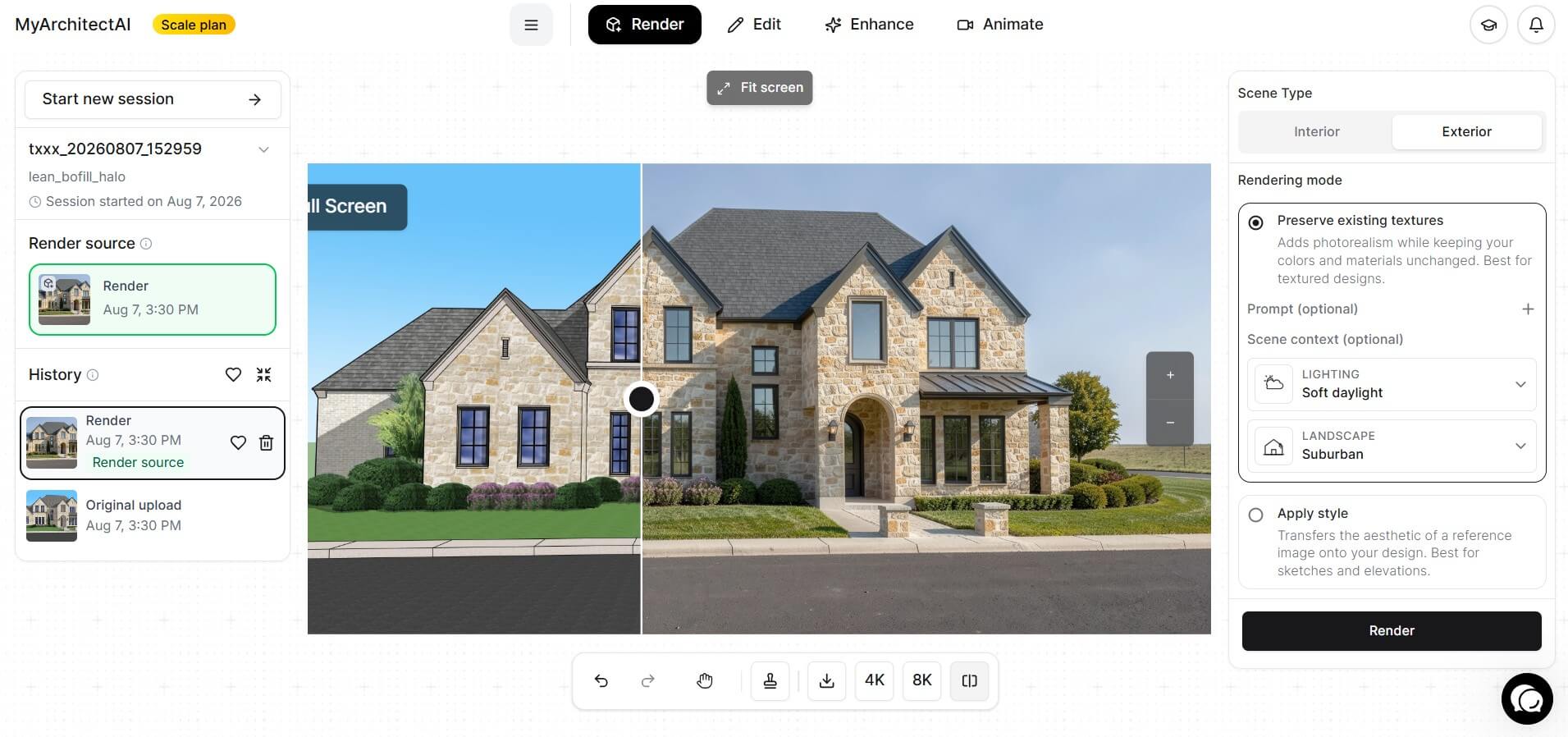
Midjourney interprets prompts artistically, which is why it’s notorious for drifting from the actual design. If you're evaluating Midjourney pricing specifically for architectural visualization, there's another, purpose-built option.
MyArchitectAI's rendering engine is designed for exactly this use case. It preserves geometry, materials, details, and spatial relationships of your CAD designs in ways a general-purpose image generator like Midjourney can't match. It's free to start, with no GPU hour tracking or Stealth Mode tiers to navigate. And without speed limits too.
Midjourney pricing looks clean on paper, but a few things push the real spend higher than the headline number suggests. Across a year of inconsistent usage with occasional overages, the effective per-image cost can run 30 to 50 percent higher than the subscription rate implies.
For regular creative work where aesthetic quality is the point – yes, particularly on the Standard plan. The combination of fast hours for urgent work and unlimited relax mode for everything else gives you a functional, cost-predictable workflow.
The value starts to erode if you need Stealth Mode (doubling your spend) or your usage is too irregular to justify a monthly subscription. It’s absolutely not worth it if the kind of images you actually need are ones where Midjourney's artistic interpretation is a liability.
No. Midjourney shut down its free trial back in March 2023 and never brought it back. There's a limited trial on the Niji Journey mobile app (iOS and Android), but the main platform requires a paid subscription starting at $10/month. If you want to test the quality before committing, the Basic plan is the closest thing to a low-risk trial.
Because of the GPU infrastructure needed to run high-quality image generation at scale. Fast mode prioritizes your jobs on high-performance servers, and that compute time costs money at volume. The bigger frustration for most professionals is that Stealth Mode, which is table stakes for client work, is locked behind a $60/month plan.
They do different things. ChatGPT with GPT Image (which replaced DALL-E 3) is bundled into the $20/month Plus plan and is significantly better at following detailed prompts and generating images with accurate text. Midjourney produces higher-quality artistic and photorealistic output for design and visualization work.
No, Midjourney doesn't offer an API at the moment. There are a few unofficial Midjourney API alternatives though but as they're not authorized by the developer, use them at your own risk.