Rhino is one of those programs you can pick up in a weekend and then spend years still discovering. The basics are friendly enough, that’s for sure. But NURBS modeling, Grasshopper, SubD, layouts, rendering, that's where most people get stuck without proper guidance.
If you're an architect or designer, the right Rhino courses can save you months of trial and error. The problem is only those hundreds of options out there, from quick YouTube playlists to multi-week bootcamps that cost over a thousand dollars.
Most Rhino courses fall into two camps: generic 3D modeling content that ignores architecture entirely, or hyper-specialized programs that assume you already know the basics. Finding something balanced is harder than it should be. So we've done the legwork for you.
Below are the 10 best Rhino courses and tutorials in 2026, covering free university-grade content, McNeel's official training, architecture-focused programs, and parametric design specializations.
| Course | Cost | Level | Format |
|---|---|---|---|
| Introduction to Rhino 8 (Rhino3D.Education) | Free for a limited time | Beginner | ~3 hrs, self-paced |
| Rhino for Architects (How to Rhino) | Custom (call required) | Beginner to advanced | Self-paced + 1:1 coaching |
| Grasshopper Pro (Hopific) | $197–$297 | Beginner to intermediate | 7 hrs, self-paced |
| The Complete Beginner Guide to Rhino (ArchAdemia) | £39/month or £159/year, discounts available | Beginner | 10+ hours, self-paced |
| Rhino 3D Certification (ThinkParametric) | $289/year | Beginner to advanced | ~15 hours, self-paced |
| Modeling 3D Patterns with Rhino Grasshopper (Domestika) | ~$28/mo or one-off | Intermediate | 4.5 hours, self-paced |
| Paracourse (Parametric House) | Subscription from $250 for 3 months | Beginner to advanced | 100+ hrs, self-paced |
| Introducing Rhino 7 (LinkedIn Learning) | $29.99/mo | Beginner | ~1 hr, self-paced |
| The Ultimate Rhino 3D & Grasshopper Course (Udemy) | $11.99–$74.99 | Beginner to advanced | 6 hours, self-paced |
| Design Computing in Rhinoceros (Coursera) | Free audit / paid certificate | Intermediate | ~3 weeks, 10 hours/week, self-paced |
Cost: Free for a limited time
Level: Beginner
Duration & format: ~3 hours, self-paced video, 2-year access
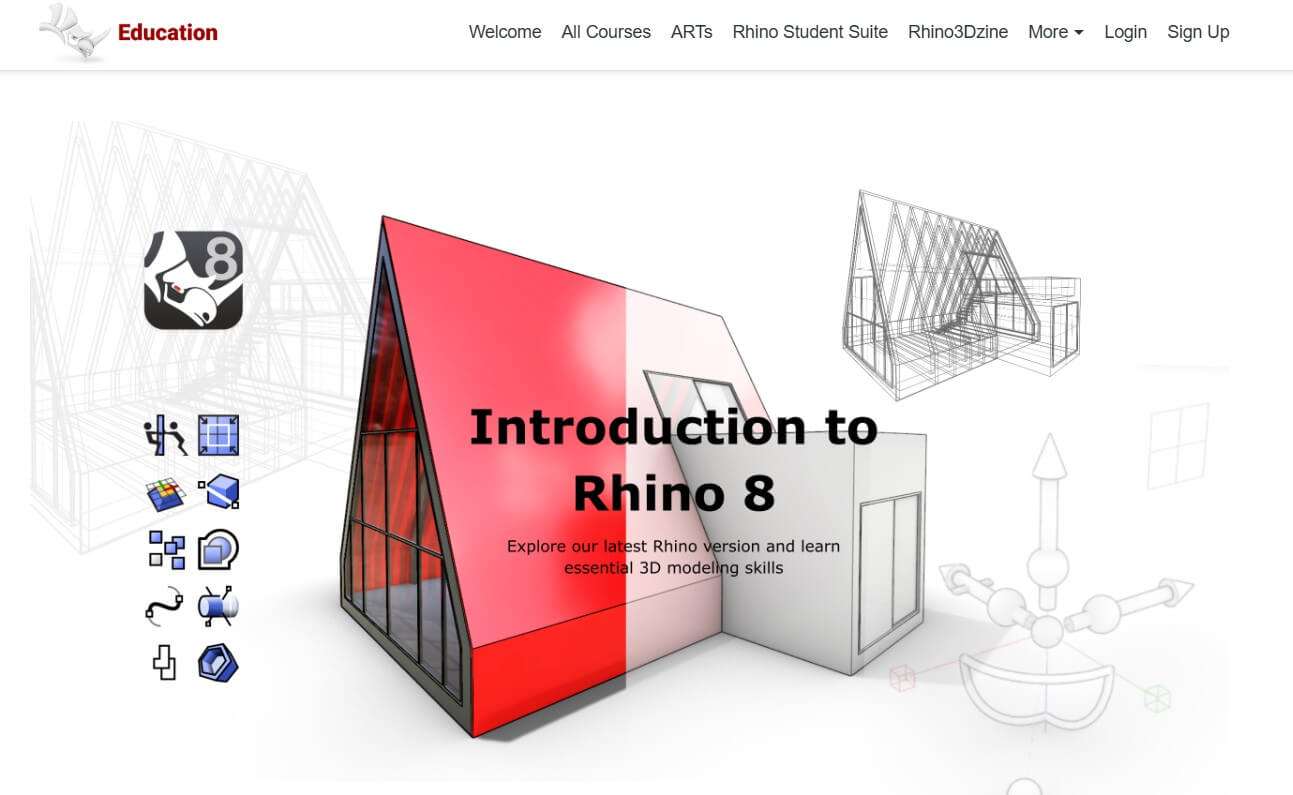
If you want to learn Rhino 3d straight from the source, this is it. Rhino3D.Education is McNeel's official learning platform, and unlike most Rhino courses, it comes directly from the team that builds the software. The introductory module was created by Andres Gonzalez (a longtime McNeel team member) along with Authorized Rhino Trainers Lucia Miguel and Julian Oquendo.
The course walks you through the Rhino 8 interface, drawing and editing curves, the Gumball, surfaces, solids (including the new Push and Pull Gumball capabilities and Shrink-wrap command), a quick intro to SubD, and a final 3D project with homework exercises.
Subtitles are available in Italian, French, Portuguese, German, and several other languages, which is rare for free Rhinoceros training. After enrolling, you keep access for two years.
It won't make you a Rhino expert, but as a structured starting point – for free, from McNeel – it's hard to beat.
Cost: Custom pricing (revealed on intro call)
Level: Beginner to advanced
Duration & format: Self-paced video + 1:1 coaching
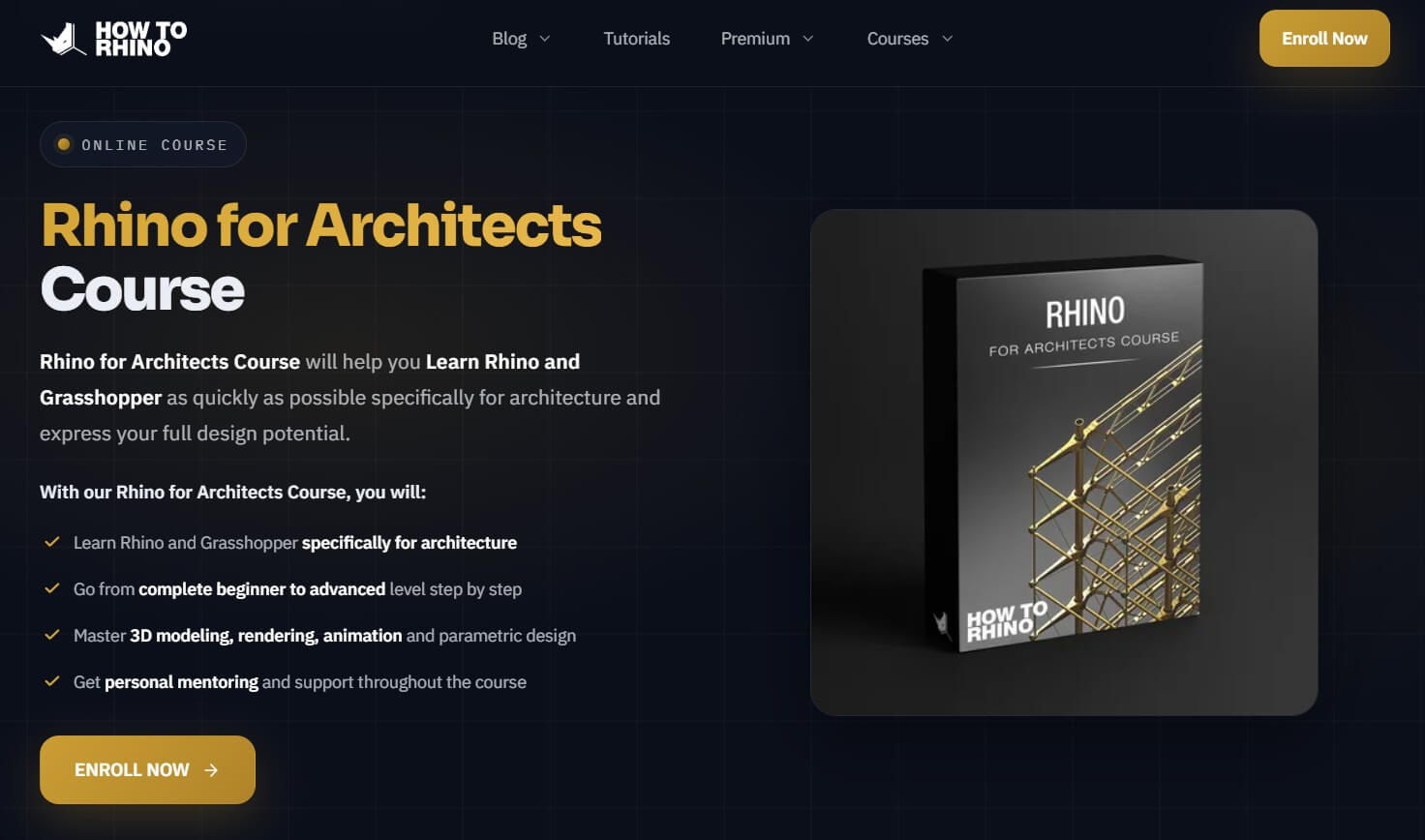
How to Rhino is an Authorized Rhino Training Center approved by McNeel, run by Dušan Cvetković and Lazar Đurić. Both have over a decade of experience using Rhino on international architectural projects.
The course is structured specifically around how architects actually use Rhino: 2D drafting, intermediate to advanced 3D modeling, organic SubD modeling (including projects inspired by Zaha Hadid and MAD Architects), Grasshopper basics, and V-Ray rendering. So if you're looking for Rhino courses for architects instead of a generic training, this one is purpose-built.
You also get 1-on-1 coaching, certificates upon completion, plus access to a private community of architects. Over 870 architects have completed their training so far.
Pricing isn't published, so you need to book a free Zoom call to get details.
Cost: $197–$297
Level: Beginner to intermediate
Duration & format: 7 hours, self-paced
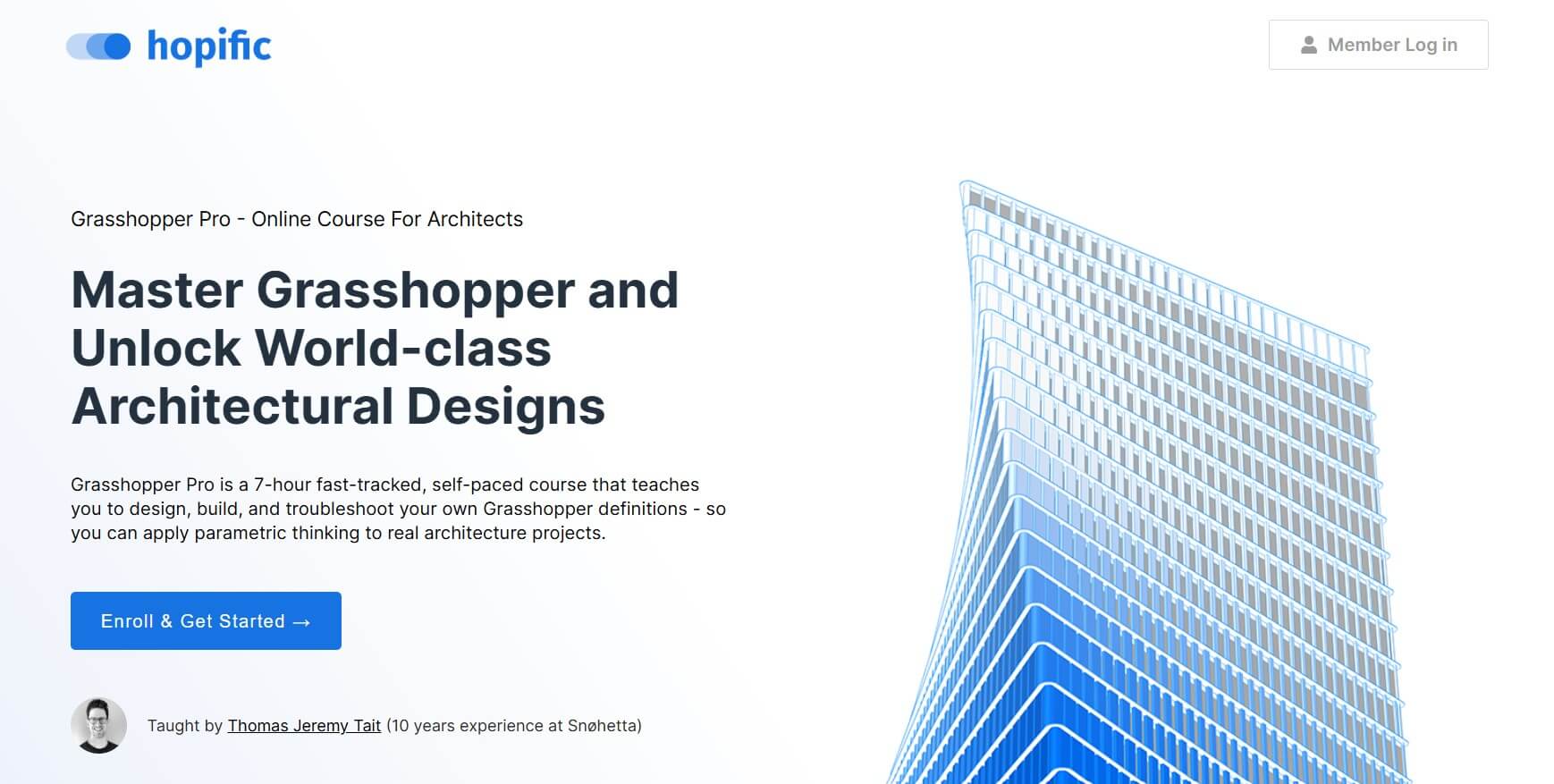
Want to actually understand Grasshopper instead of just copy-pasting scripts from YouTube? This is the Rhino Grasshopper course to take. It's taught by Thomas Tait, an architect and computational designer who used Grasshopper almost daily at Snøhetta for 10 years. He's also an Authorized Rhino Trainer.
The 7-hour curriculum covers visual programming fundamentals, the Grasshopper interface, and a deep dive into data structures (which is where most learners hit a wall). You'll learn how to build and troubleshoot your own definitions, not only follow along with someone else's.
It works on Rhino 7 and 8, on both Windows and Mac. The native components used here ship with Rhino, so no plugins are required. Lifetime access is included.
Cost: £39/month or £159/year (permanent discounts sometimes apply, membership includes all courses)
Level: Beginner
Duration & format: 10+ hours across 18 lessons, self-paced
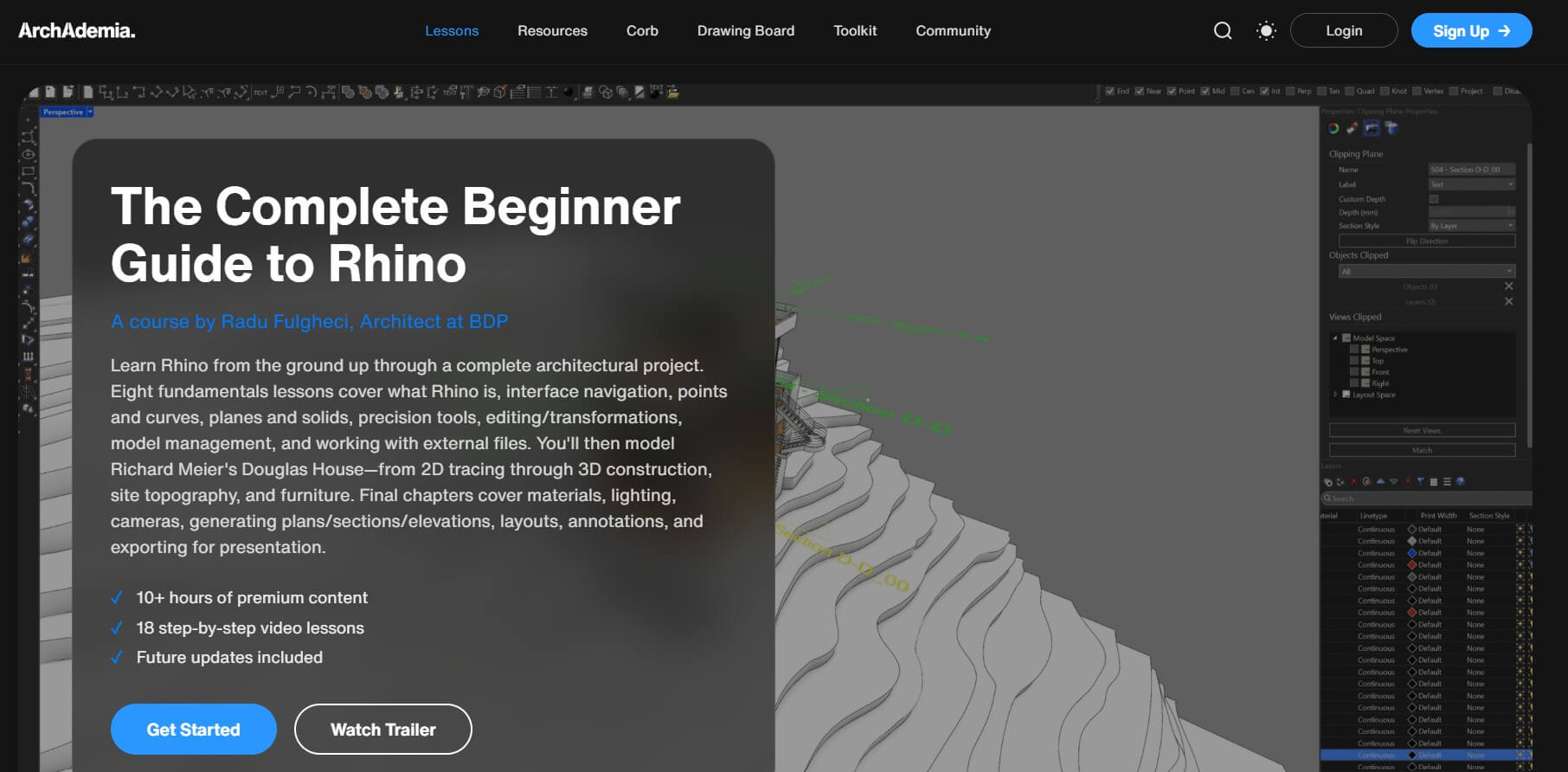
ArchAdemia is a UK-based architecture education platform that focuses entirely on real-world practice. Their Rhino course is taught by Radu, an architect with over ten years of experience across multiple modeling applications.
Eighteen lessons across four chapters cover the fundamentals (interface, NURBS, meshes, SubD, parametric capabilities via Grasshopper, file formats), then take you through Richard Meier's Douglas House as a full project. That includes 2D tracing, 3D modeling, site topography, and exporting drawings and views.
Once you're in, the £159 annual membership unlocks every other course on the platform, such as a Rhino + V-Ray archviz course built around Richard Meier's Smith House, plus a separate Parametric Architecture Masterclass that recreates Zaha Hadid's Heydar Aliyev Centre using Rhino and Grasshopper.
ArchAdemia courses also qualify as CPD for the ARB route in the UK.
Cost: $289/year (personal membership)
Level: Beginner to advanced
Duration & format: ~15 hours, 3 modules, self-paced
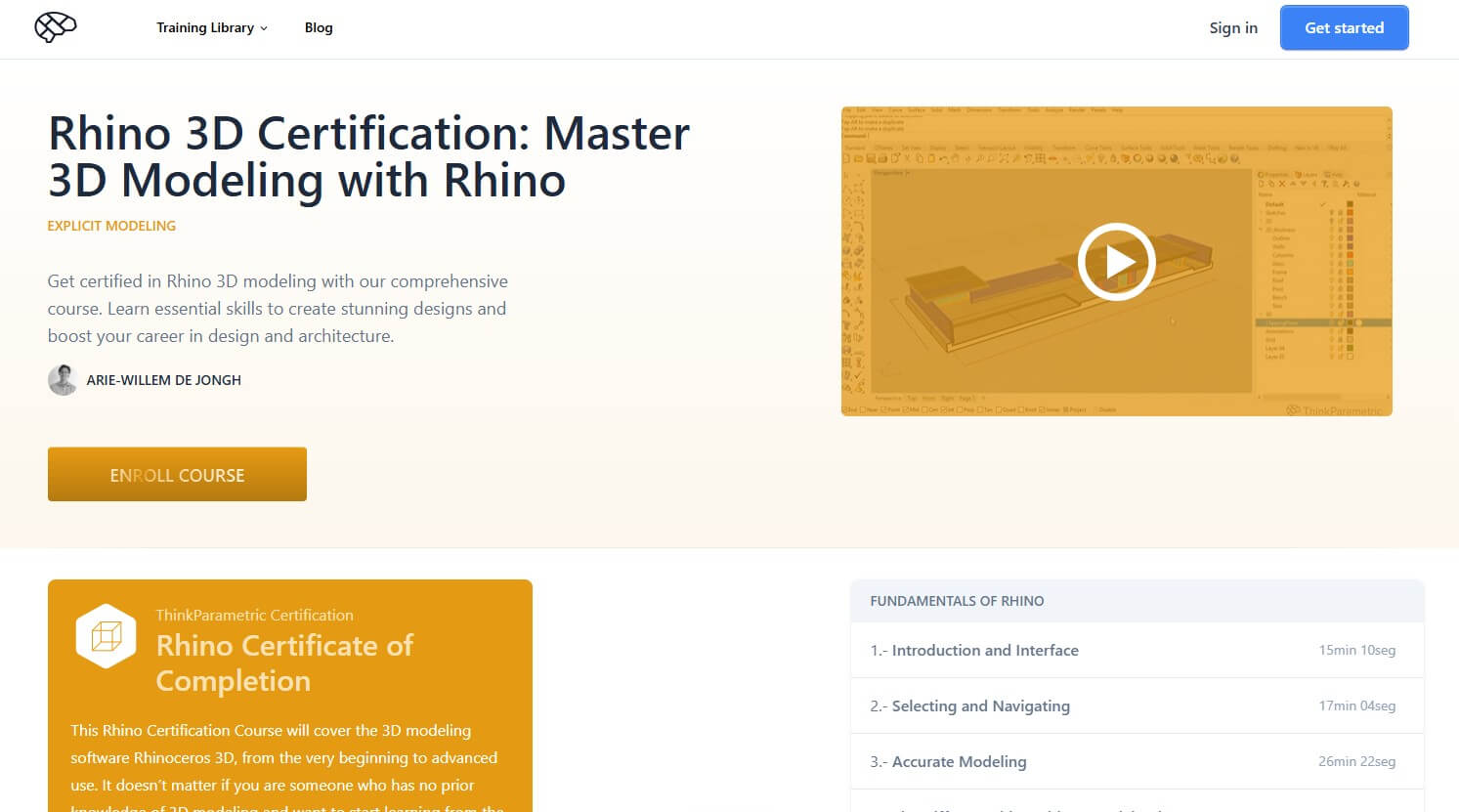
ThinkParametric is built specifically for architects, with courses created by industry leaders from firms like BIG and Gensler.
Their Rhino 3D Certification has three modules. The first covers the basics, from exploring the interface to simple construction drawings. The second module builds Mies van der Rohe's Barcelona Pavilion. The third dives into more advanced workflows: NURBS analysis for smoothness and continuity, Polygon Meshes, and SubD, all applied to modeling the roof of Zaha Hadid's London Aquatics Centre.
The annual membership unlocks every course on the platform. So beyond the Rhino certification, you can also get Grasshopper, Revit, SketchUp, Dynamo, and V-Ray.
ThinkParametric is one of the better Rhinoceros course online options if your firm wants to upskill multiple people without sending them all to expensive in-person workshops. Among the Rhino courses on this list, it's also the most certificate-driven if that matters for your professional record.
Cost: around $28/month with a Domestika subscription, or a one-off course purchase of $31.99
Level: Intermediate
Duration & format: 4.5 hours, 21 lessons, self-paced video
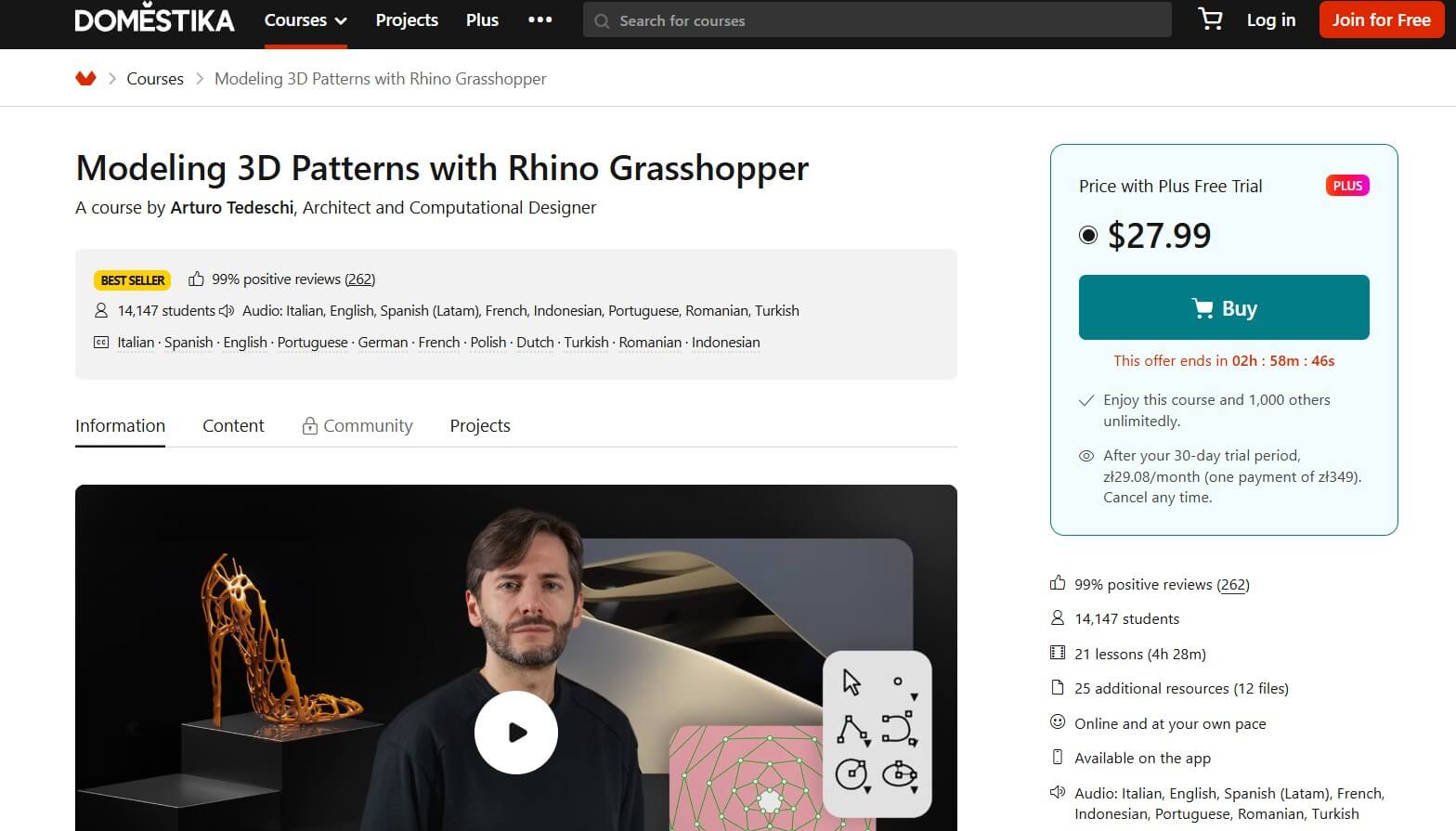
Arturo Tedeschi is an Italian architect and computational designer who literally wrote the book on Grasshopper (Architettura Parametrica – Introduzione a Grasshopper), which has been published in multiple editions and translated into English.
This Domestika course teaches algorithmic modeling for 3D patterns that work across architecture, fashion, jewelry, and product design. By the end, you'll be able to design complex parametric patterns and prepare them for 3D printing.
You need basic 3D modeling knowledge to start, plus Rhinoceros (Grasshopper is built in) and the Lunchbox plug-in. Subtitles are available in 11 languages.
What makes this one valuable is Tedeschi himself. He's been teaching and consulting on parametric design across architecture studios and universities for over a decade. You'll be learning Grasshopper directly from someone who shaped how the software is taught in the first place.
Cost: Subscription-based, from $250 for 3 months to $850 for permanent access
Level: Beginner to advanced
Duration & format: 100+ hours of video, self-paced
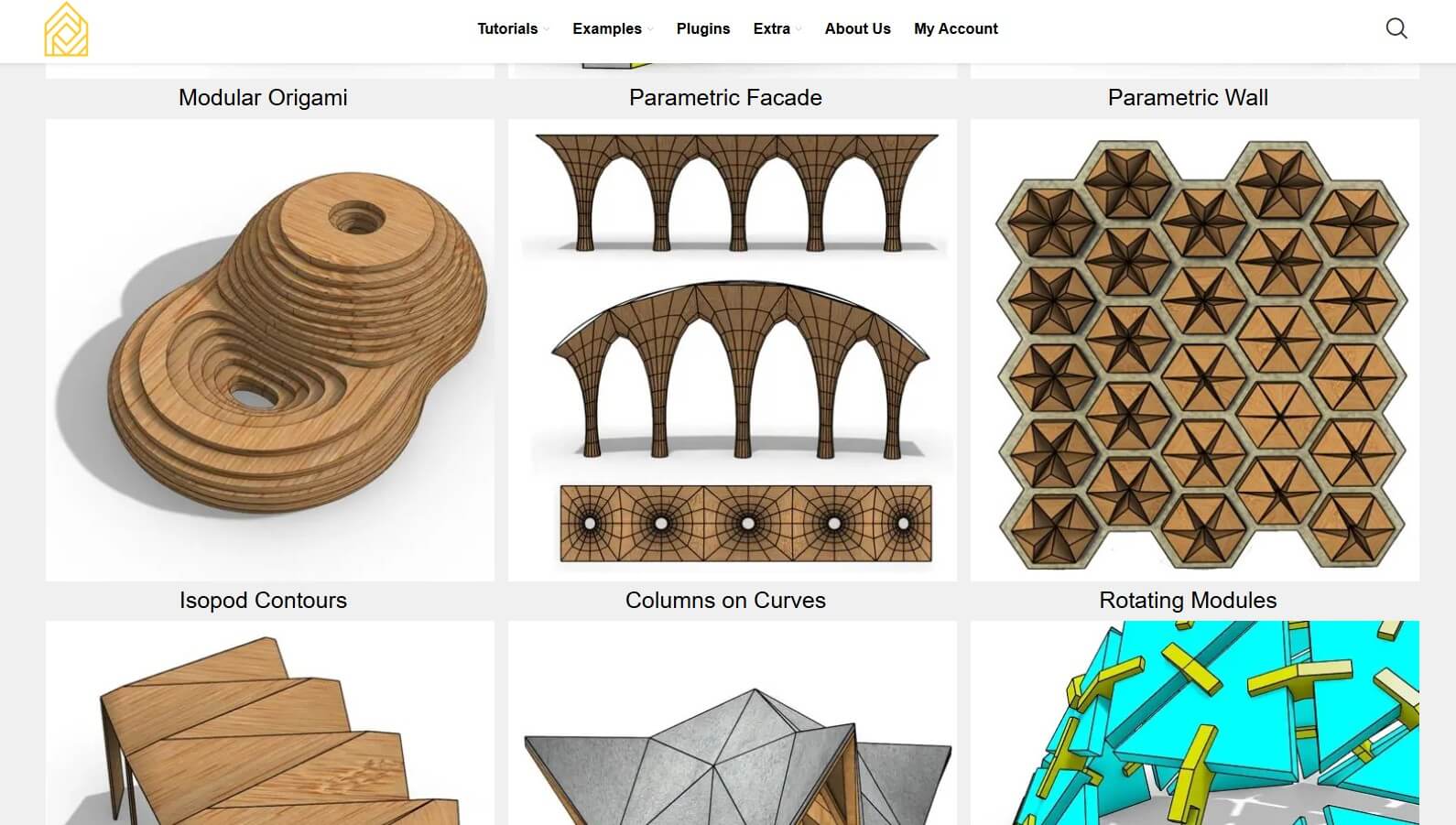
If you want sheer volume of Grasshopper content, Parametric House's Paracourse is hard to beat. Over 100 hours of step-by-step video tutorials, plus more than 1,500 editable Grasshopper files you can download and reverse-engineer.
The instructor, Mohammad, has built a reputation for clear, gentle teaching. Many of the free YouTube tutorials that helped popularize Grasshopper among architecture students came from this same source.
Paracourse works best as a long-term reference library. Lessons range from basic interface walkthroughs to advanced topics like Galapagos genetic algorithms, mesh subdivision, and image sampling. For architecture students working on competition entries or thesis projects, the editable file library alone is worth the subscription.
Cost: $39.99/month (or ~$20/month billed annually)
Level: Beginner
Duration & format: ~1 hour, self-paced

Dave Schultze has been teaching Rhino on LinkedIn Learning (and Lynda before that) for over a decade. This short course is the quickest way to get oriented if you've just installed Rhino and don't know where to start.
You'll cover the user interface, configuration and customization, curve and surface types, viewport navigation, shading modes, and how to use the built-in help system. It's basic, and that is the point—to get you up and running in an hour.
The bigger value is the rest of Schultze's Rhino library on the platform. Once you finish this one, you can move into his more focused courses: Architectural Site & Envelope in Rhino, Rhino: Architectural Interior & Detail, Rhino: From Curves to Surfaces, and Rhino: Analysis and Modeling Techniques. All of these are unlocked by the same subscription.
Cost: $11.99–$74.99
Level: Beginner to advanced
Duration & format: 6 hours of self-paced video, lifetime access
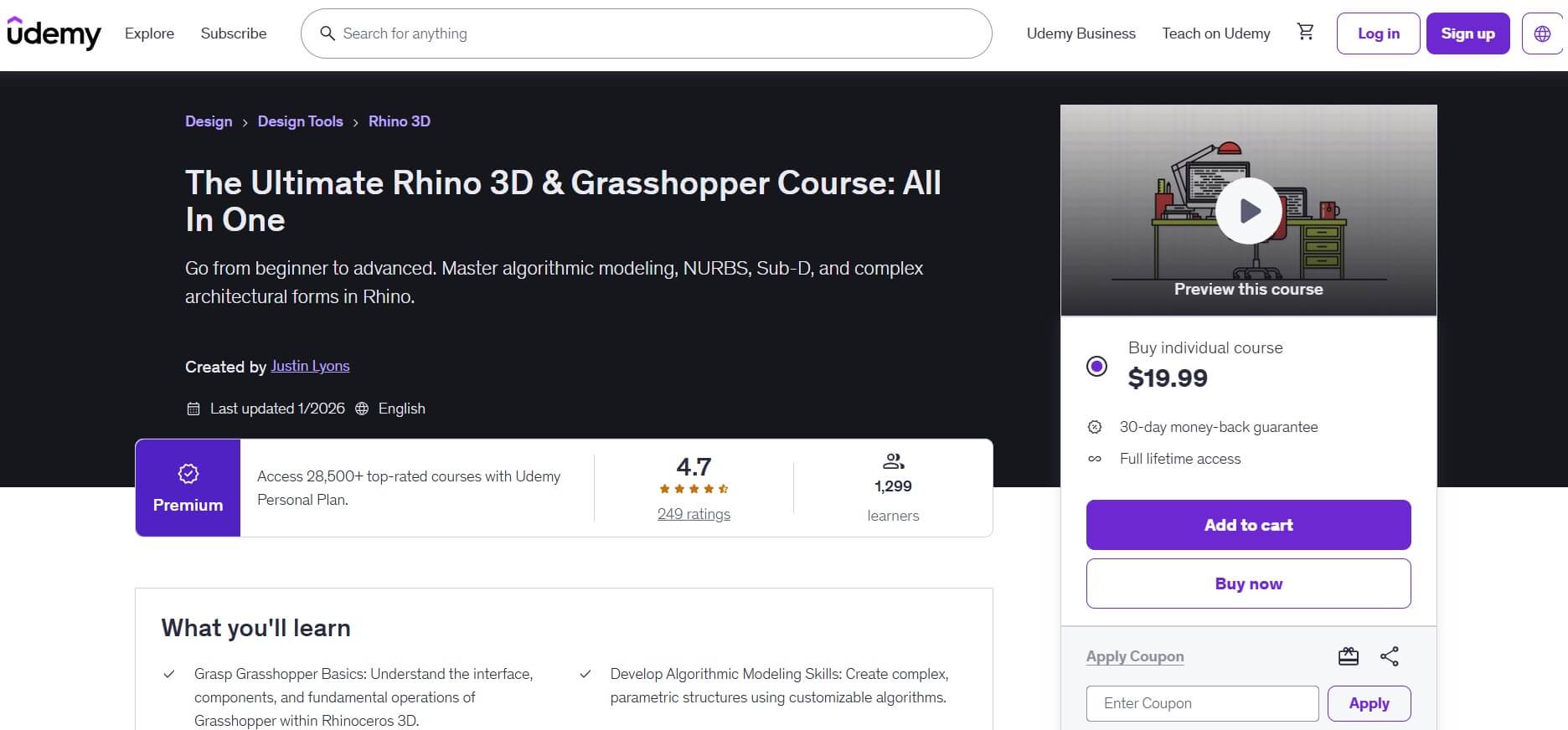
This is one of the most comprehensive paid Rhino and Grasshopper courses on Udemy in a single bundle. It's structured to take you from total beginner to a working parametric design level, with hands-on exercises throughout.
You'll cover Rhino interface and navigation, NURBS and SubD modeling, paneling tools, data tree management in Grasshopper, attractor logic (points and curves), and applied parametric examples for facades, structures, as well as organic forms.
What makes Udemy useful here is the pricing. Udemy runs frequent sales that drop courses to $19.99 or thereabouts. Lifetime access also means you can come back to specific lessons any time for a refresher.
Cost: Free to audit, paid certificate
Level: Intermediate
Duration & format: ~3 weeks, 10 hours/week
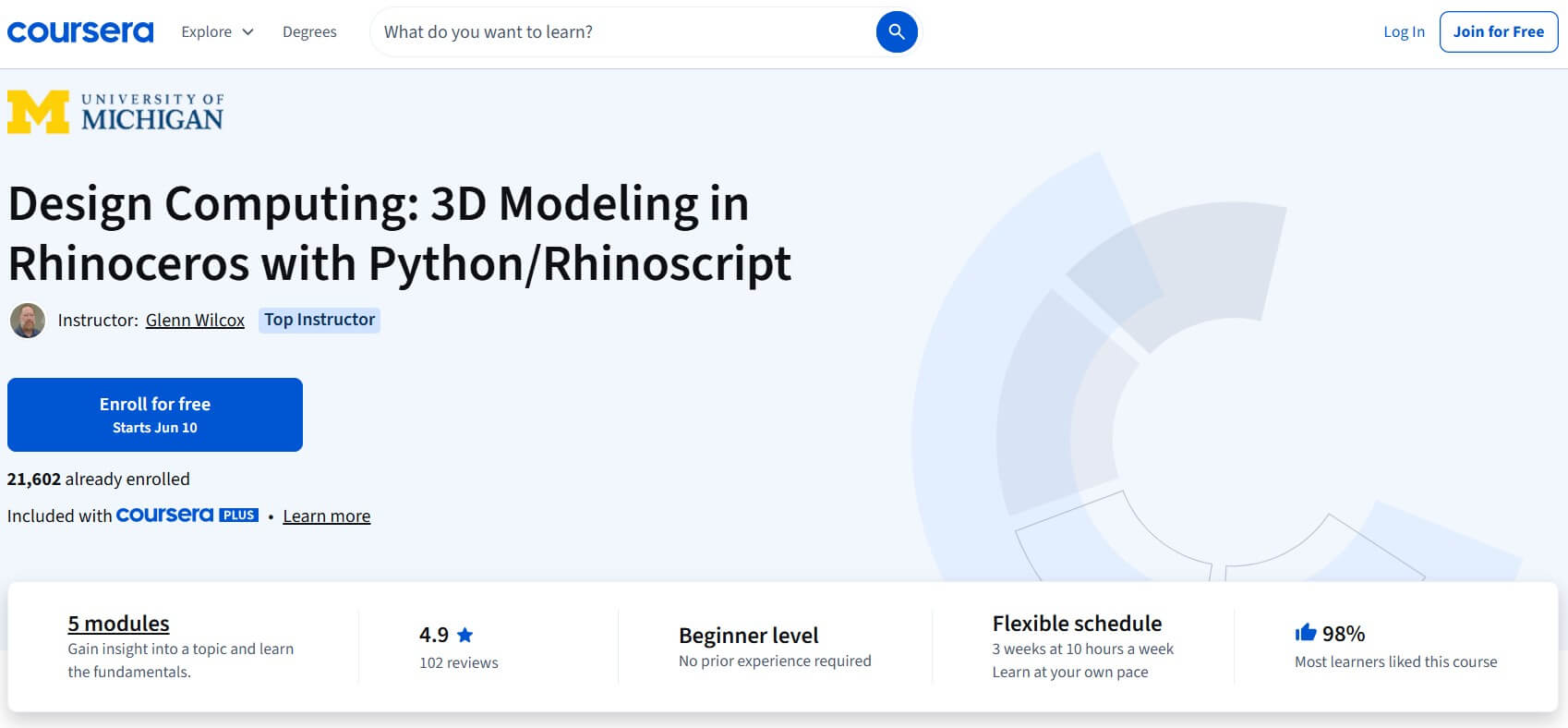
This is the most academically rigorous course on the list. Taught by Glenn Wilcox, Associate Professor of Architecture at the University of Michigan's Taubman College, it covers Python and RhinoscriptSyntax, the scripting languages that let you control Rhino geometry through code.
The five-module curriculum builds from Python fundamentals (conditionals, iteration, functions, data structures) through 2D matrix designs, 3D wall structures, and finishes with a NURBS surface tower project.
Why bother learning to code when Grasshopper is visual? Because once you hit the limits of what visual programming can do efficiently (recursion, complex data manipulation, large-scale automation) scripting takes over. This course gives you that foundation.
You can audit the entire course for free, or pay for the certificate if you want graded assignments and a credential to share.
Most of the Rhino courses on this list overlap in the basics. The differences show up in depth and specialization.
Compared to most parametric or BIM software, yes. Rhino's interface is straightforward, and you can model basic 3D objects within a few hours of opening the program. The learning curve gets steeper when you move into NURBS theory, SubD, advanced surfacing, and Grasshopper, but the basics are genuinely beginner-friendly.
That said, "easy to learn" doesn't mean "easy to master." Modeling clean, watertight surfaces for architecture or production takes practice. That's where structured Rhino tutorials for beginners pay off; they help you build good habits early.
To get comfortable with the basics, most people need 20–40 hours of focused practice. That's about a week of full-time learning, or a month of part-time study. To reach professional proficiency for architecture or product design, plan for 3–6 months. ThinkParametric, for example, suggests dedicating around 2 hours per week over 3–4 months as a solid timeline for becoming proficient with their certification courses.
A few things make a real difference: