Every few months, another headline asks the same thing: Will AI replace architects?
Some of those headlines phrase it more formally, but it's the same question with the same anxiety underneath. Most of those headlines are selling the anxiety, not an answer.
Drop in on architecture forums, and you'll see students wondering if their five-year degree is still worth it, while senior architects are quietly testing tools to see how much their teams can shrink. And things keep going further, with clients starting to ask if they can just generate a building with a prompt.
We build AI tools for architects, so we have a pretty good seat for this conversation. We see what AI can produce and where it falls flat. We watch which parts of architectural work are getting compressed and which parts are barely changing. So this piece is our honest read on where things actually stand and what working architects are doing about it, all based on what the data actually says.
So, will artificial intelligence replace architects? Not really, at least not in the foreseeable future. The longer answer is that AI is replacing specific tasks inside the job. That’s not bad news in itself, as architects who learn to use it well are pulling ahead of the rest.
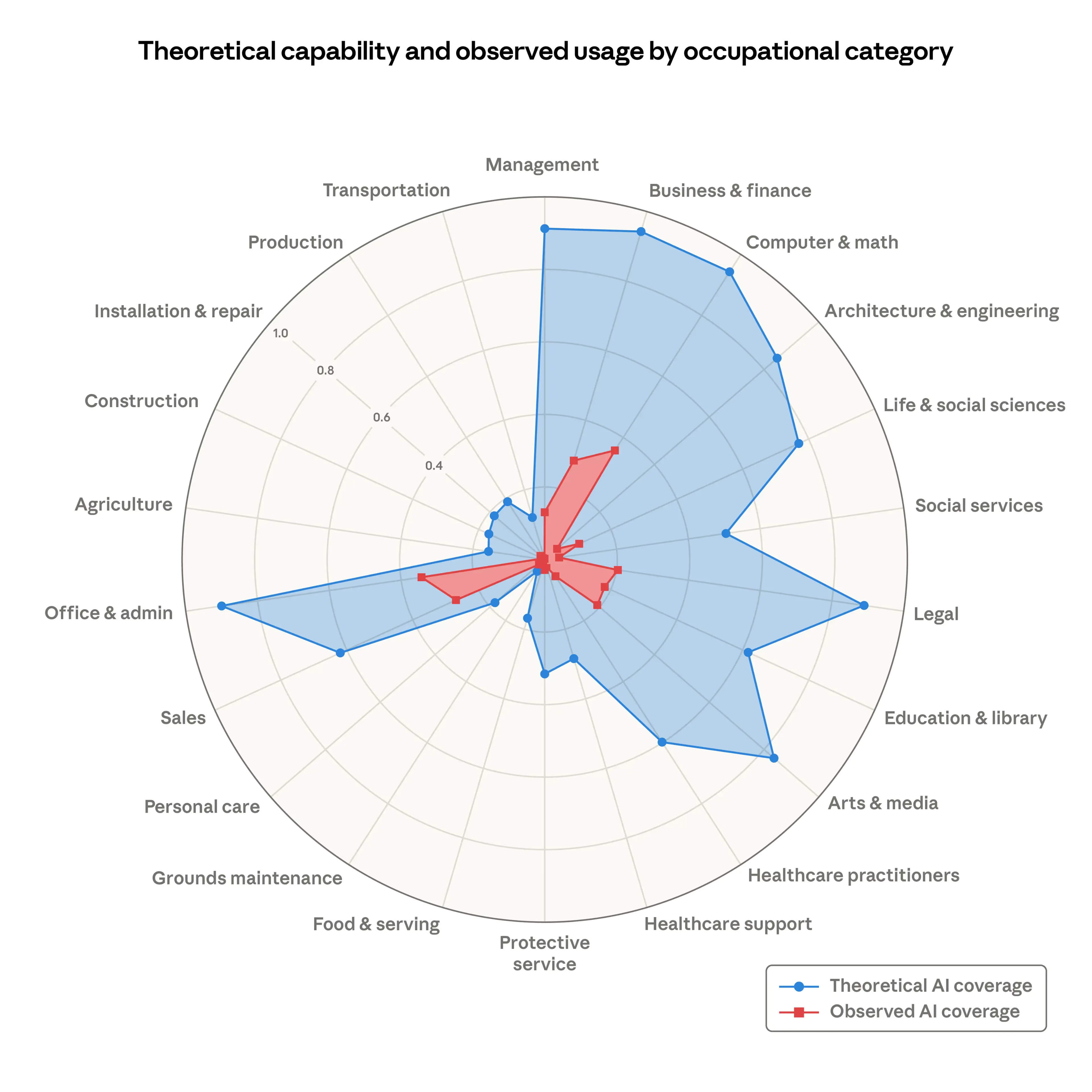
Yes, this sounds like a comfortable middle position, but the data behind it is worth looking at. Anthropic's March 2026 research paper "Labor Market Impacts of AI: A New Measure and Early Evidence" found that architecture and engineering has one of the highest theoretical AI exposures of any occupational category, at roughly 85% of tasks. On paper, almost everything you do at your desk could be sped up by AI.
Then look at what's actually happening. The American Institute of Architects' 2025 study, Artificial Intelligence Adoption in Architecture Firms, surveyed 541 architects and found only 6% use AI regularly. About 53% have experimented, regardless, just 8% of firms have seriously integrated AI into their processes.
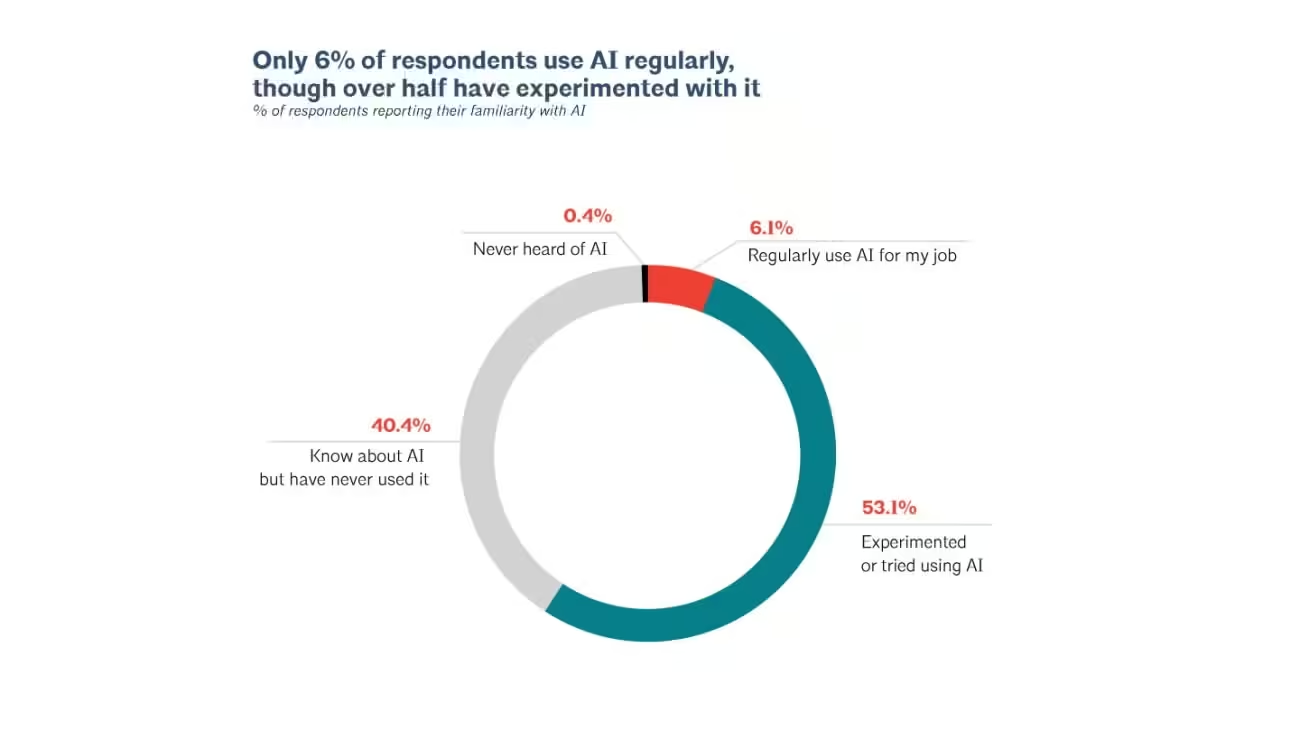
Taking all this into account, we have a profession that could theoretically be 85% AI-accelerated… with 6% adoption. That gap is the whole story. The question of “will AI replace architects” appears far more often than the question of “why so few architects are using AI in the first place”, yet the second one is far more interesting.
When people ask whether AI replacing architects is happening already, the honest reply is that automation is creeping in at the task level, especially for work that used to fill the calendars of junior staff.
Here's where AI is genuinely doing the job:
Patriarche, a French architecture firm, cut volume study time from two days to about 90 minutes using Autodesk Forma. MBH Architects shrank a two-week design options process down to six hours on the same platform.
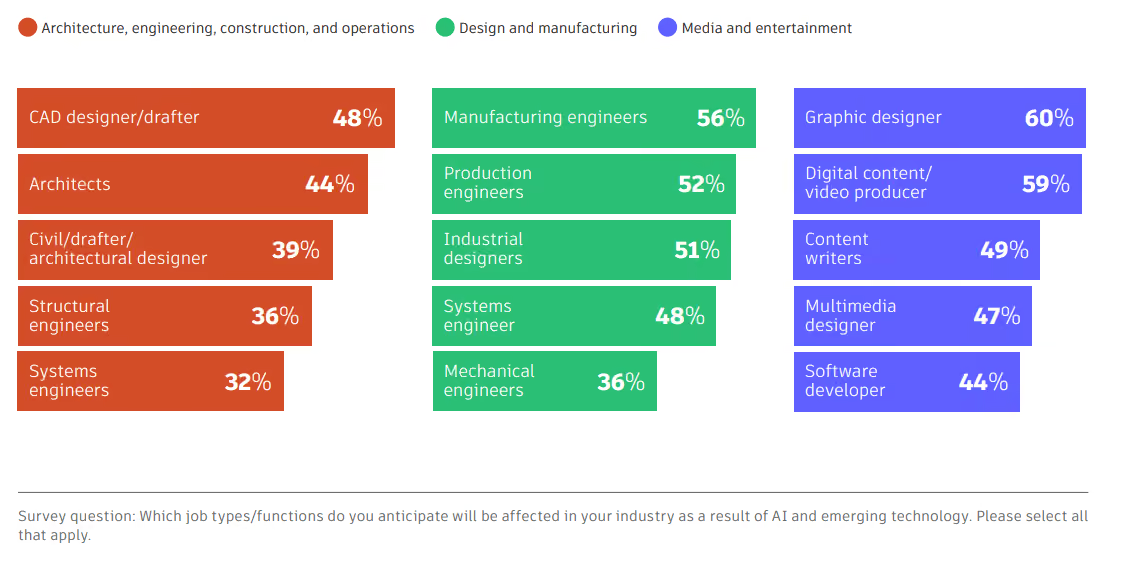
Job descriptions are changing at about the same pace. In Autodesk’s 2024 Spotlight on Skills in the Age of AI report, CAD designers/drafters were the AECO role most often expected to be affected by AI and emerging technology, at 48%, followed by architects at 44% and civil/drafter/architectural designers at 39%.
By 2025, the UK’s Digital Construction Report found almost half (49%) of architecture professionals already using AI at work, with 32% using it for drafting and reviewing text, and about a fifth applying it to project data analysis or design generation.
Now flip the question. Will AI replace architects in the parts of the job that actually define the profession? Not anytime close, and the reasons aren't soft ones about creativity or human spirit; they are structural (pun intended or not).
Phil Bernstein, FAIA and Yale lecturer, addressed this at NCARB's Futures Symposium. His answer to whether AI will replace architects was, in his words:
"not yet, and possibly not ever for the core of the work."
Liability is the cleanest reason. When a building fails, the licensed architect is the named party on the permit and the insurance policy. AI cannot hold a license. Just imagine it sitting for a deposition or carrying professional indemnity coverage. As architect Chad Reineke put it in Common Edge earlier this year:
"Contracts, building permits, and professional insurance policies continue to name a licensed architect, not a software platform, as the legally responsible party, and that responsibility cannot be delegated to an algorithm."
Then there's also the part of the job that has nothing to do with drawings. Clients rarely tell you what they actually want. They tell you what they think they want, and you spend hours pulling out the real brief. Stakeholders fight while budgets contradict the program; on top of that, communities push back on massing. AI processes explicit inputs. It can speed up some of the hassle associated with these processes, but it does a poor job of reading the room or interpreting long silences in a contentious planning meeting.
Then there's the site. Every project carries the weight of what's already there, the climate, the history, all the specificities. AI generates from pattern databases while architects synthesize from physical context. Those are different operations.
This is the question we get asked most, and requires looking at both what's in the labs and what's already deployed. Will architects be needed in the future? Yes, with a different shape to the role. The professional of record needs to remain a licensed human for legal and ethical reasons that aren't going anywhere; what changes is what fills your work day.
In the next two to three years, expect AI to absorb more of the production work: schematic options, code research, drawing coordination, energy modeling. The 6% adoption number is going to climb fast. The AIA found that nearly 70% of firms are exploring AI integration for their future business models, even if only a small fraction has pulled the trigger.
Looking further out, agentic AI systems may chain entire workflows together. You might describe a project to an interface and watch a Revit model build itself in the background. Phil Bernstein writes about this in RIBA Journal, pointing to MCP-based agents that could generate models with the architect functioning as director instead of executor.
The AIA AI Taskforce published its practical guidance for the profession earlier this year. They laid out the core human strengths AI cannot replicate. We'll paraphrase, since these get to the heart of why AI won't replace architects in any meaningful sense:
AI runs on probability and precedent, while architects work from understanding. Those are distinct cognitive processes, and the latter is way harder to fake than people who've only seen Midjourney renders assume.
Here's a pattern that says a lot about whether AI will take over architecture the way the doom headlines suggest. The AIA data shows AI adoption is heaviest at large firms with 50 or more employees, and experimentation is driven by architects under 50. The irony is, younger architects are also more concerned about AI than their older colleagues, probably because they've used it enough to see the limits.
If AI were genuinely poised to replace architects, we'd see senior partners cutting headcount and junior staff embracing it as a career escalator. The opposite picture is the signature of a tool simply finding its level inside an existing profession.
Let's be straight about one thing: the first few years of an architect's career are changing in a way that matters. The narrow version of the question we’re dealing with would be, will AI replace architects on day one of their career? That one has a more uncomfortable answer than the broader one.
Traditional junior tasks like construction documents, presentation boards, code research, and redlines are exactly the tasks AI handles best. Studios hiring in 2026 are looking for graduates who already combine 3D fundamentals with AI tool fluency, which means the "learn the production work first, design later" path is compressing fast.
Firms adapting well are pushing junior staff toward higher-value work earlier. The training curve is steeper, but the ceiling moves up faster, too. If you're entering the field now, your best bet is on judgment skills over production skills.
You might have already noticed how the phrase "AI skills architects need" shows up in every job description and continuing-ed catalog these days. Most lists you'll find online are bloated. Here's what we see actually mattering, based on the tools our users are integrating into their workflows:
You don't need to learn Python or train models. You do need to know what the tools can do, where they fail, and how to fold them into a process that still produces buildable, defensible work.
If you want to see how this works for visualization specifically, try MyArchitectAI for yourself and watch a SketchUp or Revit model turn into a photorealistic render in under 10 seconds. That's the kind of compression we're talking about. The hours you used to spend on lighting and texturing for a client meeting collapse into a few clicks, and your time goes back to the design questions that actually need you.
The roles taking the hardest hit are the ones built around repetitive, rules-based production. Drafting technicians and pure CAD drafters and BIM operators focused on documentation fall into this category. McKinsey’s research on AI in construction puts roughly a third of design and drafting tasks in the automatable bucket. Meanwhile, roles built around judgment-heavy work, like project architect or principal, are barely affected. Specialized profiles like computational designers and sustainability integrators are actually growing.
For a 15-person firm, initial AI tool investments range from $3,000 to $8,000 annually, depending on what you adopt first. AI rendering subscriptions sit around $20 to $60 per user per month. Generative design platforms like TestFit run higher, around $200 to $500 per user monthly. Our advice: start with the lowest-friction wins like rendering and code research before committing to enterprise-level generative platforms. Train your existing team. Hiring AI specialists from outside makes less sense than people think, since the tools change faster than any certification can keep up.
Absolutely, but with realistic expectations about what the work will look like. The Bureau of Labor Statistics still projects steady demand for architects, about 4% growth through 2034. Demand for buildings is going up, if anything. What's changing is the skill mix. Pure technical drafting alone is a thinner career path than it used to be, while design thinking combined with AI fluency and strong communication is a powerful combination. As Dity Ayalon of ARK said at the NCARB symposium, AI will not replace architects, but architects who use AI will replace those who don't. That's still the best summary you can rely on right now. Here are some courses on AI in architecture we recommend to keep up.
Will AI replace architects in the future? In the strict sense, no. The professional of record will keep being a licensed human, for reasons that haven't moved in decades and aren't moving now. Will the day-to-day of being an architect look different in five years? Absolutely. The tools we build at MyArchitectAI are part of why.