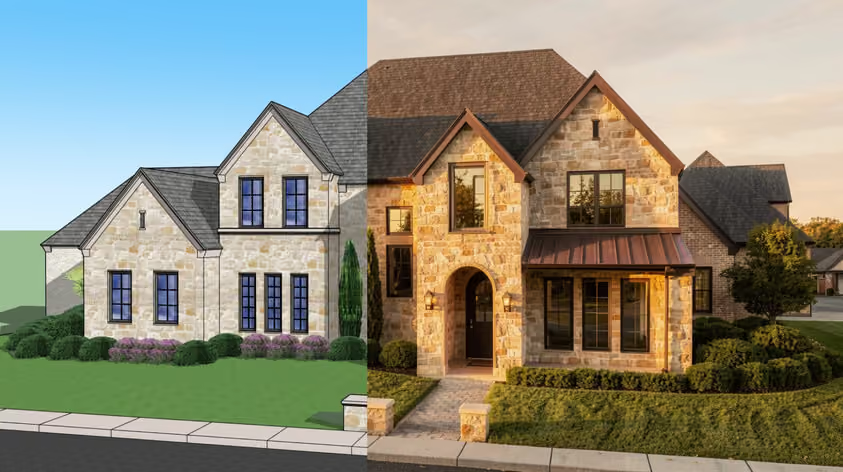
Si vous comparez D5 Render à Lumion pour votre prochain projet, vous en avez probablement assez de parcourir les pages marketing qui vous indiquent que les deux outils sont « les meilleurs ». Oui, ce sont tous deux des moteurs de rendu en temps réel conçus pour les architectes, et ils promettent tous deux rapidité et facilité d'utilisation. Mais une fois que vous commencez à examiner les détails tels que les prix, les exigences matérielles, les fonctionnalités d'IA ou les bibliothèques d'assets, la situation change.
Dans cette comparaison, nous présentons tout ce que vous devez savoir sur le D5 par rapport à Lumion en 2026 afin que vous puissiez faire le bon choix pour votre entreprise.
Avant d'entrer dans le vif du sujet, voici un aperçu de haut niveau de la comparaison entre les deux moteurs de rendu.
| D5 Render | Lumion | |
|---|---|---|
| Développeur | Dimension 5 (Weiwu Network Technology) | Act-3D (Pays-Bas) |
| Lancement | 2021 | 2010 |
| Moteur de rendu | Path tracing en temps réel (DXR) | Rastérisation + ray tracing optionnel |
| Système d'exploitation | Windows uniquement | Windows uniquement (plugin View sur Mac via SketchUp) |
| Version gratuite | Oui (Community, non commercial) | Non (essai gratuit 14 jours uniquement) |
| Prix de départ | $38/mois (Pro) | $229/an (View) / $1 149/an (Pro) |
| Bibliothèque d'assets | 14 000+ (Pro) | ~10 000+ |
| Résolution max | 16K | 8K (16K with AI Upscaler) |
| Fonctionnalités IA | Complètes (8+ outils IA) | AI Upscaler uniquement |
Gagnant : D5 Render : le traçage de trajectoire par défaut lui confère un comportement lumineux plus précis sur le plan physique
C'est là que le débat entre D5 Render et Lumion devient intéressant, car les deux outils utilisent des approches de rendu fondamentalement différentes.
Les deux outils s'adaptent bien à l'extérieur. Lumion est depuis toujours la référence pour les scènes d'extérieur, en particulier grâce à sa riche bibliothèque d'assets naturelles. D5 a comblé cette lacune de manière significative grâce à des outils de diffusion procédurale et à une végétation animée, soutenus par une bibliothèque croissante de paramètres de paysage prédéfinis. Pour les intérieurs, le traçage de trajectoire du D5 lui donne une longueur d'avance dans la façon dont il gère la pénétration de la lumière naturelle et les reflets des matériaux.
Le D5 utilise le traçage de chemin en temps réel basé sur DirectX Raytracing (DXR). Cela signifie que la lumière se comporte physiquement dans votre scène, rebondissant sur les surfaces et projetant des ombres douces en temps réel. Il en résulte un niveau de réalisme difficile à reproduire avec la seule pixellisation. Le D5 prend également en charge la technologie NVIDIA DLSS pour des performances de visualisation plus fluides tout en conservant une haute fidélité visuelle.
Quoi de neuf pour D5 Render en 2026
D5 Render 3.0 en 2026 pousse le flux de travail vers l'IA, qui permet de générer des matériaux et d'organiser les actifs sur la scène. Vous pouvez même créer de simples objets 3D à partir d'images de référence. La mise à jour apporte également de véritables surfaces de déplacement ainsi que des contrôles d'atmosphère et d'environnement plus avancés. En pratique, cela signifie une configuration de scène plus rapide et des environnements plus complets.
Lumion utilise par défaut un pipeline basé sur la rastérisation, le ray tracing en option étant ajouté dans la version 2023 et affiné jusqu'en 2026. Le ray tracing dans Lumion produit des reflets et des ombres nettement meilleurs. Néanmoins, c'est plus éprouvant pour votre matériel, et tous les effets n'ont pas encore été entièrement intégrés au pipeline de ray tracing.
Dans son mode de pixellisation par défaut, Lumion utilise certains raccourcis pour calculer la lumière réfléchie et les reflets. C'est en partie la raison pour laquelle le rendu est si rapide, mais aussi la raison pour laquelle certains utilisateurs pensent qu'il n'a pas le photoréalisme d'outils tels que V-Ray.
Si le sujet vous intéresse, nous opposons V-Ray face à Lumion dans un comparatif dédié.
Quoi de neuf pour Lumion en 2026
Lumion 2026 facilite certaines parties du flux de travail. La mise à jour élargit la bibliothèque d'assets avec des arbres photogrammétriques supplémentaires et des modèles naturels actualisés pour les scènes extérieures. Un nouvel outil de placement des zones accélère l'aménagement paysager en répartissant la végétation sur de grandes surfaces en une seule étape. L'AI Upscaler a également été amélioré, vous permettant d'agrandir les rendus jusqu'à 16K.
Gagnant : Lumion — écosystème de didacticiels approfondi, ressources communautaires plus étendues
Le D5 Render et le Lumion sont tous deux conçus pour être accessibles, en particulier par rapport à des appareils plus performants tels que V-Ray ou Corona. Mais l'expérience entre le D5 et le Lumion diffère une fois que vous êtes dans le logiciel.
Lumion s'appuie sur plus de dix ans de didacticiels et de contenus communautaires. Le D5 rattrape rapidement son retard, mais Lumion dispose toujours de l'écosystème le plus large de ressources d'apprentissage.
Lumion
L'interface de Lumion n'a pas beaucoup changé au fil des ans, et c'est une bonne chose. Si vous l'avez déjà utilisé, vous vous sentirez comme chez vous avec la version 2026. Le flux de travail se fait par glisser-déposer : importez votre modèle, extrayez les ressources de la bibliothèque, ajustez les matériaux et l'éclairage, puis effectuez le rendu. Lumion Pro est désormais livré avec des modèles de projet. Des scènes prédéfinies adaptées à différents moments de la journée, à des contextes suburbains et à des aménagements intérieurs accélèrent votre point de départ. Pour aller plus loin, nous expliquons comment régler les bons réglages dans Lumion et gagner en réalisme.
D5 Render
D5 adopte une approche similaire, bien que son interface utilisateur soit plus moderne. L'aperçu en temps réel est mis à jour instantanément lorsque vous ajustez les matériaux, l'éclairage ou la position de la caméra. L'un des points forts du D5 réside dans ses préréglages en un clic pour les paramètres environnementaux et météorologiques. Si vous voulez un éclairage doré ou une atmosphère de jour de pluie, il suffit souvent d'un clic ou deux. La courbe d'apprentissage est douce, en particulier pour les utilisateurs qui connaissent déjà les moteurs de rendu en temps réel.
Gagnant : D5 Render — prend en charge davantage d'outils de modélisation en mode natif
Si vous importez des modèles depuis votre logiciel de CAO ou de BIM, la compatibilité est importante. Voici où se situe le rendu D5 par rapport à Lumion en termes d'intégrations.
Les deux outils couvrent l'essentiel. D5 gagne sur le plan de l'ampleur grâce à la prise en charge de Blender, Cinema 4D et Vectorworks prête à l'emploi. Lumion couvre assez bien les outils d'architecture les plus couramment utilisés, mais si votre entreprise utilise une gamme plus large de logiciels 3D, D5 vous offre plus de flexibilité.
D5 Render
D5 Render propose des plugins LiveSync directs pour SketchUp, Revit, Rhino, Archicad, 3ds Max, Blender, Cinema 4D et Vectorworks. Les modifications apportées à votre logiciel de modélisation sont synchronisées avec D5 en temps réel, aucune réexportation n'est donc nécessaire. Il prend également en charge les importations de fichiers FBX et Alembic.
Lumion
Lumion Pro se connecte à SketchUp, Revit, Rhino, Archicad et à une gamme d'autres outils CAD/BIM via ses plug-ins LiveSync. La synchronisation des matériaux PBR a été améliorée dans Lumion 2026, de sorte que les modifications matérielles apportées aux outils de modélisation se reflètent désormais immédiatement dans Lumion. Lumion View (le plugin léger) ne fonctionne actuellement qu'avec SketchUp et Revit, bien que le support d'Archicad soit bientôt disponible.
Vainqueur : D5 Render — plus de 14 000 contre plus de 10 000
La qualité d'un rendu dépend des ressources que vous utilisez pour le remplir. D5 Render et Lumion le comprennent tous deux et sont fournis avec de grandes bibliothèques intégrées.
Lumion
Lumion Pro comprend plus de 10 000 modèles et matériaux : meubles, personnes, végétation, véhicules, matériaux, etc. La bibliothèque végétale est particulièrement remarquable, notamment les arbres photogrammétriques hyperréalistes introduits dans les dernières versions. La qualité est constamment élevée et le flux de travail par glisser-déposer permet de remplir rapidement les scènes.
D5 Render
D5 propose plus de 14 000 actifs aux abonnés Pro, couvrant des catégories similaires. Les modèles animés de D5 (arbres qui se balancent, personnes qui marchent, véhicules en mouvement) sont particulièrement utiles pour créer des visites dynamiques. D5 dispose également d'un outil de diffusion dédié avec des paramètres de paysage prédéfinis, qui vous permet de peindre la végétation sur toutes les surfaces en contrôlant la densité et la variété des espèces. D5 Works, une nouvelle place de marché, élargit encore la bibliothèque avec des modèles créés par la communauté.
Pour la version communautaire (gratuite) de D5, vous avez accès à environ 2 000 ressources, ce qui est suffisant pour les projets personnels et l'apprentissage, mais limité pour les travaux commerciaux. Lumion ne propose pas de niveau gratuit, il n'y a donc pas d'équivalent à comparer.
Gagnant : égalité : tous deux compatibles Windows uniquement, tous deux dépendants du GPU, spécifications recommandées similaires
Il s'agit d'un facteur décisif pour de nombreuses entreprises. D5 Render et Lumion ne produisent pas de vainqueur clair, car les deux nécessitent un matériel performant et aucun ne fonctionne en mode natif sur Mac.
Les deux outils sont uniquement compatibles avec Windows pour bénéficier de toutes les fonctionnalités. Le pipeline de rendu de D5 est basé sur DirectX 12, qui est incompatible avec macOS. Lumion n'a pas non plus de version Mac, bien que Lumion View fonctionne sur Mac via le plugin SketchUp. Aucun des deux outils ne s'adapte efficacement à plusieurs GPU.
| Composant | D5 Render | Lumion |
|---|---|---|
| OS | Windows 10 (v1809+) | Windows 10 (v2004+) or Windows 11 |
| GPU | NVIDIA GTX 1060 6GB, AMD Radeon RX 6000 lineup, or Intel Arc A5/A7 series (DXR-capable) | GPU scoring G3DMark 8,000+ (e.g., NVIDIA GTX 1060, AMD RX 580) |
| GPU recommandé | NVIDIA RTX 3060 (12GB VRAM) or AMD Radeon RX 6700 XT | NVIDIA RTX 3060, AMD RX 6700 XT, or equivalent (G3DMark 14,000+) |
| RAM | 32 Go recommandés | 32 Go recommandés |
| Stockage | SSD | SSD avec au moins 105 Go libres |
Si votre entreprise utilise des Mac, ou si vous préférez ne pas investir dans des stations de travail haut de gamme, vous pouvez envisager des alternatives basées sur un navigateur (nous y reviendrons plus tard). Nous détaillons aussi la configuration requise par D5 et celle de Lumion avec nos conseils d'optimisation.
Gagnant : D5 Render — 360 $/an contre 1 149 $/an, plus un niveau gratuit véritablement utilisable
C'est en termes de prix que l'écart entre D5 Render et Lumion se creuse. Le D5 Pro à 360 dollars par an coûte moins d'un tiers du Lumion Pro à 1 149 dollars par an. De plus, la version communautaire gratuite de D5 vous permet d'évaluer le logiciel sans limite de temps, ce que Lumion ne propose pas du tout (son essai gratuit ne dure que 14 jours).
Lumion ne propose pas non plus de facturation mensuelle. Vous êtes lié à des engagements annuels ou triennaux. D5 vous donne la possibilité de payer mensuellement si vous avez besoin de flexibilité.
| Plan | D5 Render | Lumion |
|---|---|---|
| Gratuit / Entrée | Community : Gratuit (non commercial, ~2 000 assets) | View : $229/an (plugin conception pour SketchUp et Revit) |
| Pro | $38/mois ou $360/an par utilisateur | $1 149/an par utilisateur |
| Teams / Studio | $59/mois par utilisateur ($708/an), minimum 2 | Studio : $1 499/an par licence flottante (inclut Pro + View) |
Pour les praticiens indépendants ou les petites entreprises, la tarification de D5 est beaucoup plus facile à justifier. Lumion a tendance à être plus logique pour les grands studios qui facturent les coûts de rendu aux clients et ont besoin de la reconnaissance de marque qui en découle.
Gagnant : Lumion — un palmarès plus long, davantage d'effets cinématiques, Lumion Cloud pour l'évaluation des clients
Si vous produisez des vidéos de présentation ou des présentations animées pour des clients, les deux outils de cette comparaison entre D5 Render et Lumion peuvent les gérer, chacun à sa manière.
Lumion a ici plus de maturité avec une gamme plus large d'effets cinématographiques. Le traçage de trajectoire hybride en temps réel du D5 signifie toutefois que la qualité de votre animation est généralement supérieure dès le départ, sans qu'il soit nécessaire de basculer entre des modes de rendu distincts.
D5 Render
Le D5 prend en charge la sortie vidéo 4K avec une animation de caméra basée sur des images clés et une animation de phasage pour les séquences de construction. Les éléments animés tels que les personnages et les véhicules donnent de la vie à vos visites. Son éditeur vidéo intégré est simple et le traçage de trajectoire en temps réel signifie que ce que vous voyez dans la fenêtre correspond généralement à ce que vous obtenez dans votre sortie finale. D5 prend également en charge les visites en réalité virtuelle et les présentations spatiales.
Lumion
Lumion Pro est bien connu pour les animations, prenant en charge la création de trajectoires de caméra, les transitions à l'heure de la journée, les effets météorologiques et les panoramas à 360°. La version 2026 a ajouté des outils de placement de zone améliorés pour peupler rapidement de grands espaces extérieurs, ce qui est utile pour les projets paysagers nécessitant beaucoup d'animation. Lumion Cloud vous permet désormais de partager des visuels rendus directement avec les clients à des fins de révision et de balisage.
Gagnant : D5 Render avec plus de 8 outils d'IA
C'est sans doute la partie la plus intéressante de la comparaison entre D5 Render et Lumion en 2026, et le domaine dans lequel les deux outils divergent le plus.
D5 Render
La boîte à outils d'IA de D5 Render est complète. À partir de la version 3.0, il inclut :
D5 Lite, leur nouveau plugin SketchUp, ajoute la conceptualisation de l'IA au traçage de chemin en temps réel. Vous pouvez passer d'un modèle de masse approximatif à une image conceptuelle stylisée sans quitter SketchUp.
Lumion
L'offre d'IA de Lumion est plus limitée. La principale fonctionnalité d'IA de Lumion 2026 est l'AI Upscaler, qui prend désormais en charge la mise à l'échelle 2x et 4x (résolution jusqu'à 16K) à l'aide de cartes normales et de profondeur. Il est performant dans ce qu'il fait : produire des agrandissements prêts à imprimer à partir de rendus à faible résolution. Mais comparé à la vaste suite d'IA de D5, il s'agit d'un outil à usage unique.
Si l'accélération des flux de travail basée sur l'IA est importante pour votre entreprise, D5 a clairement une avance sur ce point. La force de Lumion réside dans son flux de travail traditionnel raffiné, et non dans l'innovation en matière d'IA.
Si la rapidité et la simplicité sont plus importantes pour vous que la création manuelle de scènes, des outils tels que MyArchitectAI AI adopter une approche complètement différente.
Au lieu de configurer manuellement les scènes et de modifier les matériaux, téléchargez votre design (depuis SketchUp, Revit, Archicad ou tout autre outil de CAO) et laissez le moteur d'IA s'occuper de la visualisation. Il fournira des résultats photoréalistes en moins de 10 secondes, sans aucune courbe d'apprentissage.
MyArchitectAI fonctionne entièrement dans votre navigateur, il n'y a donc pas de configuration matérielle requise ni d'installation. Mieux encore, il fonctionne sur Mac, Windows, tablettes et téléphones. À 29$ par mois pour des rendus illimités, cela ne coûte qu'une fraction du D5 ou du Lumion.
MyArchitectAI ne remplace pas les moteurs de rendu complets pour la création de scènes. Vous ne créerez pas encore d'animations personnalisées ni de procédures pas à pas en réalité virtuelle. Mais pour les présentations rapides aux clients et les itérations de conception, il comble une lacune que ni D5 ni Lumion ne comblent particulièrement bien. De nombreuses entreprises l'utilisent conjointement à un moteur de rendu traditionnel : MyArchitectAI pour accélérer le développement de la conception, et D5 ou Lumion pour les résultats finaux et soignés.
Gagnant : Lumion — L'évaluation du cloud avec des liens orientés vers le client et aucune connexion requise est actuellement plus pratique pour la plupart des entreprises
Alors que les studios se développent et que le travail à distance devient la norme, la collaboration est importante. Ces deux outils investissent dans la collaboration, mais sous des angles différents. D5 se concentre sur la création de scènes collaboratives, tandis que Lumion se concentre sur la révision et le feedback collaboratifs.
D5 Render
D5 for Teams inclut des projets partagés avec synchronisation des versions et un espace de travail cloud pour le partage des ressources d'équipe. Il nécessite un minimum de deux sièges à 75$ par mois chacun. Les fonctionnalités de synchronisation en temps réel permettent aux membres de l'équipe de travailler sur des scènes qui restent coordonnées entre les postes de travail (mais pas de manière aussi complète que le font les plateformes BIM).
Lumion
Lumion Cloud vous permet de télécharger des rendus et de les partager via un lien. Les clients peuvent les consulter à l'aide de balises visuelles et d'un historique des versions sans avoir besoin d'une licence Lumion ou d'une connexion. Lumion Studio ajoute également des licences flottantes, qui peuvent être partagées entre les membres de l'équipe qui n'ont pas tous besoin d'y accéder simultanément.
Gagnant : Lumion — 15 ans de profondeur d'écosystème, c'est difficile à égaler
Si vous appréciez un vaste écosystème de support bien établi, Lumion a l'avantage. Si vous êtes à l'aise avec une communauté plus petite mais enthousiaste et réactive, D5 ne vous décevra pas.
Lumion
Lumion existe depuis 2010 et a construit une énorme communauté. Ses didacticiels officiels complets et sa base de connaissances bien entretenue sont soutenus par des revendeurs agréés qui fournissent une assistance localisée. Même l'équipe de support interne de Lumion est composée d'architectes et de spécialistes de la visualisation.
D5 Render
Le D5 est plus jeune mais croît rapidement. Son forum communautaire est actif, des didacticiels et des webinaires officiels sont régulièrement publiés et il propose un programme de certification pour les utilisateurs et les instructeurs. D5 organise également des événements communautaires régionaux et entretient des partenariats avec des revendeurs dans plusieurs pays.
Alors, où vous mène cette comparaison entre D5 Render et Lumion ? Voici un guide rapide.
Choisissez D5 Render si :
Choisissez Lumion si :
Envisagez un outil d'IA basé sur un navigateur tel que MyArchitectAI si :
La comparaison entre D5 Render et Lumion en 2026 est différente de ce qu'elle était il y a quelques années.
Lumion possède toujours la marque la plus forte et l'écosystème le plus large. Cependant, D5 a discrètement développé un moteur de rendu capable d'égaler ou même de dépasser Lumion en termes de qualité de rendu et de capacités d'IA à une fraction du coût. La licence annuelle de Lumion coûte environ trois fois ce que vous paieriez pour le D5 Pro, et le D5 inclut une version gratuite.
Pour les entreprises qui ont déjà investi dans l'une ou l'autre, le changement de fournisseur entraîne des coûts réels. La reconversion des équipes et la reconstruction des bibliothèques d'assets prennent du temps.
Mais pour tous ceux qui choisissent pour la première fois entre Lumion et D5 pour la première fois, D5 constitue un argument solide. Associez-le à un outil d'intelligence artificielle tel que MyArchitectAI pour les moments critiques pour les clients, et vous obtenez un flux de travail de visualisation à la fois rapide et abordable.